Saturday, April 2, 2016

​​SMPGs: The Heart of SENG

Today we have a guest post by Kate Bachtel, current Board of Directors Chair of SENG (Supporting Emotional Needs of the Gifted). Thanks, Kate, for sharing with us!
“The concept appears to be a paradox: ‘Instruction’ and ‘conversation’ are often antithetical, the one implying authority and planning, the other equality and responsiveness. The task of teaching is to resolve this paradox. To most truly teach, one must converse; to truly converse is to teach.”(Tharp, Estrada, Stoll Dalton and Yamauchi, 2000, pp. 32-33)
SENG Model Parent Groups (SMPGs) are the heart of SENG. The objective of these facilitator guided groups is to unite diverse caregivers of complex, gifted children and provide space for each of us to learn from one another’s expertise and experiences in a nurturing, non-judgmental environment. While not counseling or therapy sessions, SMPGs provide space for critical conversations on how to best support the healthy social and emotional development of individual gifted youth.   

In many ways, by encouraging authentic dialogue among caregivers, SMPGs promote harmony and are a model of the continued evolution SENG would like to see occur both in classrooms and society. 

Last year, SENG engaged in a comprehensive evaluation of the SMPG program. We collected quantitative and qualitative data from active SMPG facilitators and recent participants via both surveys and interviews. The anonymous surveys encouraged honest, unfiltered responses and attempted to prevent positive self-impression response distortion. Here are a few highlights of what we learned.

SMPG Participants Report Transformational Experiences. All but one survey participant reported their SMPG experiences exceeded expectations. Additionally, participants rated their facilitators’ skills nearly uniformly as superior. Here is an example of the of feedback we received:

“This group was SO badly needed for my family. Other families I know need a group like this too, but this particular time did not work out. I wish everyone with challenging gifted kids could attend this program!”

“I do not feel alone now.”

“I’ve learned to communicate better with my child, and it is working.”

“I honestly feel this group saved my family!”

“My child is a happier child, my family is a healthier family, and I’m a better person as a result of this group. Thank you!”

SMPG Facilitators Hold Tremendous Expertise and are Mission-Focused. While SMPG facilitators are not trained as clinicians, approximately eighty percent have more than twenty-six hours of formal professional development in the field of gifted. Moreover, nearly two-thirds of participants rated their SMPG experiences as “delightful” or perfect on our Likert scale. The survey also reinforced our perceptions that facilitators are mission-driven. When asked why they facilitate groups, facilitator explanations align with the purpose of SMPGs: to grow understanding of gifted children, remind parents they are not alone and create safe spaces for parents to connect and share.

This year, SENG is prioritizing taking better care of our SMPG Facilitators. Here are a few things to keep an eye out for:
  • More opportunities for SMPG Facilitators to connect, share latest research and best practices (including an exclusive, facilitators only event at conference).
  • Additional SMPG marketing and promotion support.
  • Increased administrative support, including with registration and book distribution logistics.
  • Focused attention on recognizing the contributions and achievements of expert facilitators.
  • Creation of an SMPG Board Champion Position. Interested in applying for this volunteer leadership opportunity? Please click here to learn more.  
The SMPG Program Chair will lead decision making for SMPG related program decisions
  • soliciting input from fellow directors as needed.
  • soliciting input from fellow directors as needed.
  • Lead annual strategic framework SMPG program goal creation process.
  • Point person for collecting data to monitor program progress and to report on progress of annual SMPG program goals.
  • Insure program diversity goals are met as outline in strategic plan.
  • Engage in outlined rounding practices to support healthy community growth.
  • Lead SMPG Facilitator recruiting in partnership with the Executive Director.

The Launch of SMPG + Parent Retreats
In response to feedback from both facilitators and participants, SENG will be piloting a one day SMPG + Parent Retreat in 2016. This workshop format will cover core SMPG topics. The structure will alternate discussion with frequent breaks for movement, meditation, lunch and to connect with family at home throughout the day. While the discussions will be structured in a similar manner to the traditional SMPG model, parents will be held in the comfort of tribe for a full day (8am-4:30pm). We expect this format will help us reach families whose schedules do not align with the traditional eight-ten week program. Our goal will be for all to leave feeling relaxed, replenished and empowered with expanded community and expertise. We already have three SMPG + Retreats scheduled for May. 


Registration for the Boulder retreat on May 10th is live now!


Keep a lookout for more to come!

Monday, November 30, 2015

Surviving the Holidays with a House Full of Gifted!


With a family peopled by half introverts and half extroverts, our family has always had mixed needs at the holidays.  In general, we manage to spread the activity over multiple days.  My husband's family takes Christmas morning and evening, with a nice long nap (and a little food prep) in between.  Scheduling downtime throughout our holidays has been our lifesaver for many years.

Mornings used to start very early, at the crack of dawn, with stockings only.  The kids could see over the balcony to the tree and presents below, but nary a stockinged foot could touch the downstairs floor until the 'rents were up.  Stockings full of little gifts and gadgets delay the inevitable while allowing those sleepy parents (us!) a few extra minutes of sleep.

Christmas brunch is at the house with the youngest kids who can't just be strapped into an infant seat.  For many years, that meant our house; now we head out to my sister-in-law's home for a lazy morning of Uncle Brad's homemade eggs Benedict, Aunt Kim's fruit salad, and our monkey bread. Did I mention it's a lazy morning?  We all show up in our PJs!  Holiday sleep pants, t-shirts and slippers grace our Christmas morning photos.  There's time later for dress up, but for the morning, everyone's relaxed and comfy.

After opening the presents from cousins, aunts & uncles and grandparents, everyone heads home for a food-coma-induced nap.  Yes, a nap, in the middle of Christmas day.  I highly recommend it!  This nap / time to play quietly with gifts gives our over-intense kids and their sleep-deprived parents a break before the family dinner.

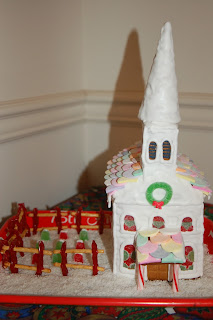
Gingerbread churchDinner doesn't vary much from year to year, and that works well for this bunch.  Last year we added a pescetarian entree to the beef tenderloin entree for our eldest niece, our future pastry chef and pescetarian (most of the time). But from the sparkling grape juice to the Christmas cookies made at home and at Grammy's in the preceding weeks, consistency creates comfort for intense gifted kids.

Speaking of traditions, we sneak one of our holiday traditions in the weekend before Christmas... Gingerbread Houses! Extended family and friends get together to create our personal masterpieces and enjoy our traditional pre-Christmas meal, Hot Cheese Monkey.  Check out our Holiday Traditions.

The week between Christmas and New Year's includes more family gatherings, on both of my sides.  The highlight here is "Pollyanna."  None of the kids seem familiar with the old movie of the same name, but they all know what Pollyanna means.  In my large Irish family, families with birth-18yo kids exchange names, and instead of purchasing dozens of tiny gifts (there are 22 of us, just at my generation!), we only purchase one present per child we have in Pollyanna.

And once kids are too old for Pollyanna, there's the Yankee Swap!  My kids are both over 18 now and seem to look forward to Yankee Swap more than they enjoyed the Pollyanna gift exchange.  If you'd like to participate, bring a small wrapped gift.  Everyone draws a number; number 1 is the best because you get to go first and last, and in order, everyone picks a present to open.  The catch is, you can pick something from the pile, or steal something that's already been opened. Each gift can be stolen up to two times. It's fun to see which presents are popular (The Math Behind The Simpsons, who would have guessed!) and which you're 'stuck with." If the present is clothing, you must put it on immediately. It's fun to watch aunts, uncles and cousins parading in the passed-down-year-after-year red union suit.  Just remember, wrapping can fool you... as it did the proud owner of a 20-pound bottle of dill pickles last year!

Like other family events, downtime is scheduled into Pollyanna, and a large, loving, calm Irish Setter is a great thing to curl up with on the floor of the rec room.

For our family, the key to surviving the holidays is a combination of family, traditions, and downtime, with a cat or dog thrown in for good cuddling.  Happy Holidays!

This blog is part of Hoagies' Gifted Blog Hop: Surviving the Holidays.  Click here to read all the great blogs in the hop this month, and enjoy lots of great ways to de-stress the holidays, no matter what you celebrate!


Sunday, February 1, 2015

Gifted Testing: A Beginner's Guide

Gifted Testing. What is it? Why should we do it? What are the best tests to use? What do the results mean? And most often asked... How can I prepare my child for Gifted Testing?

How can I prepare my child?

Let's start with the easiest question first. This is easy, you ask? Sure! Preparing your child for gifted testing is just like preparing her for a good day at school. Relax the night before, get a good night's sleep, have a well-rounded breakfast that includes plenty of protein and not too much sugar. But isn't there more to it? Not really. Test prep, while common in high-stress school systems (New York City comes to mind), is not only unnecessary, it can be counter productive. If we parents are stressed over the idea of gifted testing, our gifted kids will be, too. And that kind of stress rarely improves test scores. In fact, with sensitive gifted kids, quite the opposite may be true; stress may lower their test scores.

Meanwhile, a very well-prepped child may score a little higher on the tests... which may be enough to get a high-achieving but not gifted child into the gifted program. Doesn't that help the child? Not at all. That well-prepped child is still the same child, and the extra depth and speed of a good gifted curriculum is unlikely to serve him well. Meanwhile, the social benefits from being grouped with your academic peers are lost on him, as he's no longer with his peers, but in over his head. For more on prepping your child for Gifted Testing, read Aimee Yermish's How Can I Prepare My Child for Testing?

When should I test my child?

This may be a simple question: the school tests all kids in second grade. Or it may be complex: my child is struggling in school, and it seems like the classroom material is too simple, or he is very different from the other kids and isn't fitting in, or she can't sit still after he's completed his assignments. Gifted Testing may be part of a more comprehensive assessment, looking for a combination of achievement, intelligence, possible learning disabilities and more. But when is the right time to test?

The best time for Gifted Testing is when you have a significant question to be answered. You'd like your child to attend a school that requires Gifted Testing for admission. Or there's a higher level classroom available in your own school or district, but your child must "test into" the class. Or your child isn't fitting well in school, and you need an assessment to see if she's ADHD or LD or (yes, it's possible) gifted.

There is one question that is NOT a good question to answer by testing: Is My Preschooler Gifted? We all strive to be good parents, to follow our child's lead, to interact and spend time with them. Whether your preschooler is gifted or not, you will parent them the same way: with unconditional love and support. You will still spend lots of time together outdoors, and talk to her wherever you go. You will still read together whenever you can, and have him help with cooking and cleaning and shopping. Testing to determine if she reaches that "magic" number won't change anything. If Gifted Testing won't change anything, it's not a good time to test.

It's best to wait until your child is at least 6 years old before Gifted Testing (if possible). This way he can skip the less reliable years of preschool testing, when scores are less consistent over time, and kids are more squirrelly with the tester.

For more, read Why should I have my child tested?

What is Gifted Testing?

Gifted Testing means different things in different districts and states. In many districts, gifted testing starts with a group screening test, designed to determine which kids should go on to further assessment to possibly participate in the gifted program. These group tests, including the OLSAT and CogAT, are usually grade-level, multiple choice achievement / ability tests. For gifted assessment, many tests recommend that potentially gifted students are given a test one level higher than their grade level, so that they have "ceiling" room, and the school can differentiate between the high-achieving student who is at the top of her class, and the gifted student who is beyond her current grade level.

Publishers also provide a "margin of error" for their assessment, which should be added and subtracted from the target test score to include either 65% or 95% of the students who should be included in the program. The larger the margin of error on the test, the larger the confidence interval will be. For example, if the margin of error is 3 and the "cutoff score" is 130, then you should include all students who score 130 +/- 3, or 127 and up (since we want to identify all students at 130 *or higher*). The publisher tells us that this interval would include 65% of the target population. If your school wants to be certain to include 95% of the gifted kids in further assessment, they would have to use twice the margin of error, 130 +/- (2*3), or 124 and up. Easy enough. However, some gifted assessments have much higher margins of error. A margin of error of 7, for example, would require students with scores of 116 and up to be included in further assessment, to have the same 95% confidence interval.

Some Gifted Tests aren't tests at all. Instead, they are surveys, with components for the teacher and possibly the parent to complete. This type of Gifted Test requires that the teacher be well-trained on the characteristics of giftedness. However most U.S. teachers receive no gifted education training in their pre-service education, and only those who intentionally select it receive gifted education training in Continuing Education or advanced degree programs. The parents are similarly handicapped, because unless they are teachers, scout leaders or other instructors of same-age children, they are unlikely to know just how different Abby is from her "average" classmates. Even with other children and extended family, the nature vs. nurture research tells us that Morgan's family peer group is likely to be skewed. Her parents will likely have no average child at home to compare to, and may answer the survey questions incorrectly as a result.

Survey-type Gifted Tests are also likely to underestimate the giftedness of non-native-culture kids, and kids who are seen seen as having "difficult" traits such as speaking out when they're finished their own work, complaining about the classwork due to boredom, or moving around in the classroom. Kids who have both gifted traits and learning disabilities are often thought to be "average" because assessments may try to average their strengths and weaknesses. But having gifted strengths and LD weaknesses is far different from being average in all areas!

Some states and districts require individual IQ tests for gifted identification. This is the most accurate means of identification for most students, but like any one-time measure, it may be only as good as the combination of factors that occur at that moment. Does the test style suit the child's strengths and weaknesses? Is the tester hurried or stressed? Many gifted kids can sense this; this sensitivity is one of the characteristics used for identification. Is the child well today? Is he hungry? Is she tired? Is the room too hot, too cold, or full of distracting noises? Is the kindergarten playground occupied right outside the window? Was he pulled from lunch, or recess, or his favorite subject?

The most common individual IQ tests are the WISC and the Stanford Binet. But no matter what Gifted Test your child might take, you can learn more on Hoagies' Page: Tests, Tests, Tests. This inventory of tests given to gifted kids for various reasons includes links to lots more information, no matter what test or assessment is used.

What's the difference between in-school testing and private-assessment? The short answer is, in-school testing gives you results: scores. Private assessment evaluates the whole child, and gives you a report with score, what they mean, implications for education and suggestions for your child's future. Julia Osborn provides more detail in Assessing Gifted Children

What do the test results mean?

Often the test results are more confusing, rather than more clarifying. So much child is in this percentile, with that standard score, and the other grade level... what does it all mean for my child's education? Before you can decipher the results, you may need to ask for a full score report. It's required for the school to make a full report available, but often, they give only a summary, or only a single number that means either she's "in" or he's "out." The federal law FERPA allows parents to ask the school, and see the full score report and any other contents of your child's records at school, including the cumulative folder (usually the one in the office with only attendance and grades) and more personal records kept with the counselor or psychologist.

Once you have the full score report for each test, you can begin to discern the meaning in the results. A quick guide to test scores, and how different tests and their scores compare can be found in What Do the Tests Tell Us?. And for those confusing variations between ability and achievement tests with scores that sound the same, read Why do my child's test scores vary from test to test?

Widely scattered test results don't necessarily mean that your child is both gifted and learning disabled, often called twice exceptional or 2e. But those variations in scores definitely deserve futher attention, and a psychologist should be able to point you towards others assessments that may give you more information on the variations in your child's scores.

Now you know everything you need to know about Gifted Testing!

Well, not really. For lots more information on Gifted Testing, read David Palmer's Parent's Guide to IQ Testing and Gifted Education**. I stand by my review, as true today as when the book was first published, "Not just every parent of a gifted child, but every teacher and every guidance counselor of gifted children, too, should read Parent's Guide to IQ Testing and Gifted Education. Palmer explains all in one book, what it took me years of talking to dozens of gifted professionals to learn for myself. And Palmer makes it easy to read, with review points at the end of each chapter - if you're in a hurry, read the review points first, and pick the chapters that answer the questions you have right now. But read the whole book cover to cover when you have time - it's worth it!"

**Hoagies' Gifted Education Page is an Amazon affiliate; Amazon purchases made through this link support Hoagies' Page.

 
This blog is part of Hoagies' Gifted Blog Hop: Testing. Visit and read all the great blogs, from parents, teachers, students, gifted coordinators and more!

Sunday, November 30, 2014

Holiday Traditions!

Without our traditions, our lives would be as shaky as... as... as a Fiddler on the Roof!

What traditions will your kids remember next year, in 20 years, for a lifetime? Will he remember the piles of presents, or that Grammy and Grandfather took all the grandkids to the theater every holiday? Will she recall that "perfect gift" you bought for her when she was 3, or 10, or 16, or will she remember the year Daddy's gingerbread house was a train station with the town clock on top (it's always 5 o'clock somewhere!), or the year she created a wonderland gingerbread castle that looked a little like Hogwarts, in red and black on a shimmering lake of silver nonpareils?

Traditions create memories.

What are your holiday traditions?

Ours are simple. Every year, on the Saturday before Christmas, Grammy and Grandfather take all the grandchildren to the matinee of the Holiday Panto at our local theater. Each year, the kids search excitedly to see what this year's Panto will be, and what role their favorite actor will play. They have to see Mark Lazar!

Then when they return, we have the family traditional dinner in the oven: Hot Cheese Monkey. One of the kids is sent down to the "dungeon" to catch the Monkey, and we all enjoy this traditional egg, cheese, bread and sausage or ham casserole, served with cooked and raw carrots for the veggie, and pickles on the side, because... well, because it's a tradition, this one passed down from my husband's grandmother, Gran. For some reason, no one seems to need dessert.

And we decorate gingerbread houses. This tradition is old enough to have taken on a life of it's own. The extended family, and now boyfriends and girlfriends, all join us for gingerbread houses, each with his own house and her own theme. And each year their Dad creates his "secret" project. No one knows what it will be until he's done. Grandfather helps the little ones, while Grammy creates amazing snowmen and other hand-built decorations for whoever wants them. As the kids are growing up, sometimes she even decorates her own house!

We collect the decorations for weeks beforehand. There are always graham crackers for constructing add-on porch roofs or school bell towers, ice cream cones for church steeples, and Necco wafers, Christmas colored nonpareils or frosted shredded wheat for roofing materials. There are gummy lifesavers to turn into wreathes, and licorice allsorts that become stepping stones or window candles, roofing materials or presents under Peeps Christmas trees.

And then there are this year's unique candy finds, those special decorations that we've never seen before. These new decorations delight and inspire! A few years ago, it was chocolate "rocks." They turned into a rocky hillside a garden path, and a rock garden for the turtle. No one knows what new surprises are in store for this year!

One year, we had a Jewish gingerbread house and a Muslim gingerbread house. The kids researched to be certain to provide thoughtful decorations, and they learned about different cultures in the process. Gingerbread as social studies!

Another year, we had a spring house with beautiful spring flowers, a lake and a garden path. And another saw a Halloween masterpiece. One year was a "foil" theme - kisses wrapped in various colored foils were stripped and the foil used to roof and decorate. Last year included an attached garage with a lift-opening door and a candy car stowed inside, at the end of the gingerbread house's driveway. I'm told a black-and-white theme might be featured on one house this year; I can't wait to see it!

Like most traditions, this one isn't quite so simple. We collect candies for months before, making certain we have fruit-striped gum and gummy bears to become sleds and their passengers, holiday M&Ms, and plenty of coconut and mini marshmallows, so everyone can have their "snow of choice."

The gingerbread must be made in advance, and even that's another fun family tradition. We've discovered new gingerbread house molds over the years, including last year's coup thanks to a new boyfriend: a gingerbread train mold! eBay is our friend, for buying out-of-print gingerbread molds. We've mastered forming the dough and then peeling it out onto baking trays to speed the process, but baking 12+ houses is still a two-day adventure. We have egg-white powder to make Royal Icing, and we assemble all the houses at least a day in advance of decorating. We learned the hard way that Rome was not built in a day, and Royal Icing needs a day to set firm!

It's worth every minute of the prep to watch our kids and their cousins, and parents, too, sitting around the tables, passing candies back and forth, sharing ideas and keeping secrets until the big "reveal," and making tons of great memories.

And year after year, the question is always the same... not when will we shop, or what am I getting, but what day is the Panto and Gingerbread Houses?

Traditions!


If you still need a little something to wrap, visit Hoagies' Gifted: Smart Toys and Games. You'll find tons of toys and games for gifted kids and families, all reviewed by gifted kids for gifted kids. These are the toys and games that last more than one day or even one play, bringing years of joy, without driving gifted parents completely batty.

Click Next Blog to continue to the next blog in this month's loop, all featuring wonderful ideas for holiday "giving"... Let's say Bye-Bye to Buy-Buy this holiday season, and make memories our kids will remember for a lifetime!

This blog is part of Hoagies' Gifted Blog Hop on Holiday Gifts: Bye-Bye to Buy-Buy. Click here to visit the Blog Hop page, and find all the blogs PLUS a bonus Pinterest Link! And from here, you can visit all the great past Blog Hops, including Gifted Advocacy, Gifted Friendships, The "G" Word, and lots more...

Friday, October 31, 2014

Be sure to adjust your own oxygen mask before assisting others...

We've all heard it, whether on a plane or in a movie. In the unlikely event of a change in cabin pressure... Please be sure to adjust your own mask before assisting others. It's good advice. If you try to help others first, you may lose consciousness from lack of oxygen yourself, and be unable to help the other person anyway. It's really good advice.

...Good advice that we rarely listen to in our own lives. Are you the parent of a gifted child? Are you overwhelmed, exhausted, or just plain "spent," trying to keep up with your own life, and your kids? Put on your own oxygen mask before attempting to assist those around you!

But what does this mean??

As with everything else in this crazy parenting journey, the meaning varies with the individual. For some of us, it means going out for a run, whether around the block or 26.2 miles, a marathon. For some of us, it means spending an hour in yoga or meditation; for others it means spending 5 minutes by yourself, alone, in the bathroom. At least for a few years. But even those 5 minute time-outs count.

For many of us, the last time we spent ANY time for ourselves, doing what we wanted to do, has faded into a distant memory, a mirage on the rear horizon. That's not a good thing.

Whatever we do to take care of ourselves, it's important that we actually DO it. It's important to take care of ourselves before we try to take care of our kids and spouse (in no particular order). It's even more important for our kids to see us taking care of ourselves--our minds, bodies, eyes, relationships--they need to learn to do the same thing for themselves.

Whatever you do for to relax and rejuvenate yourself, keep a few things in mind. First, keep your eyes in mind. Our eyes require exercise, particularly, they require changing focal length to keep their flexibility and youth. We laugh at the ads for Presbyopia on the TV or in magazines, but our eyes do age and harden, and the more we exercise them, beginning in early youth, the better. Do you spend your days working on a computer? Take 2 minutes every hour to focus on something outside your window. Better still, GO outside the window and exercise your eyes, lungs, and skeletal muscles all at once with a few minutes walk.

Next, keep those muscles in mind. What we eat is important, but we could consume the best diet in the world and without exercise, we would not be healthy. Exercise doesn't need to mean distance running or lifting weights; it can be walking around the garden and pulling weeds. Winter doesn't mean that you can't go outside to exercise. Put on your heavy coat and gloves and get outside to admire the ice on the trees, the snow on blades of grass, or the view from the top of the ski slope. Summer where you are? Go for a walk around the mall or the library, in the nice cool air conditioning.

Don't forget to exercise your brain! Use it or lose it turns out to be sage advice for more than just our bodies. Recent research suggests that for many older adults, the decline in mental facility is related to their choice to use or stagnate their brains. In other words, learning, solving puzzles, and keeping mentally nimble is as important to offset the effects of aging as exercise and stretching is to offset the effects of aging on our bodies. Yes, the crossword puzzle or Words with Friends really is our friend!

I'm as guilty as the next person. I spent years of my life in the same routine, day in and day out. I sat in my car commuting to work, where I sat and stared at the computer for hours on end. The only thing I exercised was my fingers... typing. I didn't even have a window anywhere nearby to look out and refocus my eyes. Then I came home and played with the kids, but by then it was usually board games... it was dark out. Cooking, shopping, that was a little exercise, but something for my sanity? Not so much. And I must admit, it's slightly easier to do things for myself now that we are officially "empty nesters," though not nearly as much easier as I expected.

We also need emotional "exercise." For those of us with spouses or significant others, this means spending time together. Preferably together alone. For those of us without significant others it may look different, but it's still spending social time with others who do NOT need their diapers changed, their shoes tied, or their homework supervised. You know, other grown-ups. Not just working in the same cube-farm with others, but spending enjoyable time with them, perhaps dining, talking, book club, or many other forms of adult social interaction.

A few years ago, my husband stumbled on it. He found something that gets us outside and has us exercising our eyes in close and distant viewing. Something that exercises our brains in puzzle solving, observation and learning. Something that exercises our bodies, a little at a time (that's all I can handle; I have limited mobility), but for those who are able, offers miles of hiking, biking and even a little diving and climbing, if you're so inclined. And better yet, something that has us spending time alone together, talking, working on puzzles together, then at other times has us socializing with other adults who share our interest. What is it?

All my friends are grinning now. They know what I'm about to say. Some are as hooked as we are; others haven't tried it yet, and perhaps think we're a little nuts. Two are personally responsible for introducing us to our new activity. Yes, it's...

Geocaching. A global treasure hunt that over 6 million people are playing today. The perfect geek, er, gifted adult activity. Every geocache is a puzzle to be solved, a treasure to be found. Some are so simple you can park the car, step out and grab them. Others require hours of research and puzzle solving, while still others require hours of hiking and searching outdoors. There are over 2.5 million caches active on all 7 continents, plus one in the International Space Station, but that's a "terrain 5" - specialized equipment required. And among those 2.5 million there are caches for everyone, no matter how mobile you are, or how much puzzling or hiking you are looking for.

Geocaching has taken us to historical places near and far, including many we never knew existed. We've learned geology at home and in our travels. We've solved puzzles, simple and amazing; we've even created a few of our own for others to solve. We've met tons of people, and made many friends. And yes, we've improved our health. Not bad for a treasure hunt game!

Geocaching is just one solution, our personal "oxygen mask." What's yours?

Click to continue to the next blog in this month's loop, all featuring amazing self-care suggestions and success stories...

This blog is part of Hoagies' Gifted Blog Hop on Gifted Advocacy. Visit all the blogs in this hop!

Sunday, September 28, 2014

Advocacy... the story of my life

Advocacy. I always said I wasn't good at it. I talk too much, I'm not good at being "politically correct," and I often put my foot in my mouth... at least when it's about my own kids. I get emotional. I'm not a good advocate for them, though I am persistent. That's a good quality for an advocate.

And yet, it's something I find myself doing time and again. Daily, it seems. A cousin who's second grader is facing the new school year having to "prove" himself again before he can get the enrichment that kept him sane in first grade last year. A friend who's 4th grader is going nuts with the mindless math homework, and needs something to encourage him to bother doing it... like harder homework. Another friend who's 9th grader isn't welcome in Sunday School any more, because the leader is suddenly uncomfortable with her being grade accelerated. Advocacy seems to be my middle name.

So what have a I learned over the years? What can I tell folks to help them make their own advocacy better accepted? And why couldn't I have thought of these things years ago, when I was advocating for my kids? Can't turn back the clock, so I'll focus on the future.

And honestly, that's good advice. Don't focus on the past. What can we do today to improve the gifted child's life tomorrow? There's no point in rehashing the past for minutes and hours. It doesn't help, but it does make folks feel bad; usually folks on both sides of the table. When advocating, let's start with today, and look forward.

Take the other person's perspective. That sounds simple, but often it actually is. Yes, the teacher is making life difficult for your child. But sometimes your child makes life difficult for the teacher, too. And then there's the rest of the things the teacher must be to the kids in her class: teacher, mentor, guide, disciplinarian, food provider, and lots more. All the while she may be worried about her own job, if her students' test scores aren't high enough.

But how can you help these things? They're not in your control. You can't do them for the teacher. Ah, but you can make her life easier, by advocating for options that don't require her to work harder. Like what, you ask? Like homework. It's easy to differentiate homework for one student, and when that student is your child, you're motivated to do it. You can even volunteer to share the differentiated homework with the teacher so she can use it with other children. No, she might not have any other 2nd graders who need 4th grade math homework, but hey, at least you offered!

Another important part of seeing things from the school and teacher's perspective is saying "yes." The teacher is concerned that your child might need more time to develop her social/emotion skills? Yes, I had that concern too. I look at the gifted literature, and found that there's research indicating that excess repetition can actually have a deleterious effect on the gifted child. Let me send bring you a copy (send you a link, whichever you'd prefer) to that research when we're done meeting. Now, I can help you with differentiating for my child by....

And how do you differentiate math homework? Easy! Take your child to the educational supply or the wholesale club, and let her pick out a math book from a grade or two (or more) higher, and buy it. When the homework comes home, replace the grade-level worksheets with similar topic worksheets from the higher level book. The second grade homework is simple subtraction? Replace it with multi-digit subtraction, then add borrowing as soon as your child can handle it. The homework is shapes? Replace with more complex shapes. Telling time to the 1/2 hour? Telling time to the 5 minutes. Easy.

This approach solves many problems. It makes the child far less frustrated with the below-level worksheets for homework. He learns that his parents are working on his behalf, trying to bring more learning into his education. At the same time, the teacher sees what the child really can do, what level he is really working at. And this is his level without any instruction!

For my kids, changing out the homework kept them happy for a year or so while we advocated for the next step: subject acceleration, in our case, in math. But these techniques work just as well in reading, writing, science or social studies. For subject acceleration in math, we advocated for several different options, presenting them as a selection for the school to pick from. Some of the methods were more labor intensive at the school (requiring work by the teacher), some required a little scheduling (allowing the child to go to a higher grade for the subject), while others had a cost associated (signing up for a complete online course). We suggested that the online courses would make the teacher's life easier, and our goal was not to make more work for the teacher, but instead, to make her life easier... while still meeting our child's requirements in education.

The next step in advocacy is often a much bigger step: full grade acceleration. But that's a topic for another post.

For more on Gifted Advocacy, visit Hoagies' Gifted: Advocacy page. There you'll find links to research and success stories, and everything in between. Gifted Advocacy guides, Myths vs. Realities, and more.

For more on creating your own Advocacy Support group, read The Care and Feeding of Gifted Parent Groups: A Guide for Gifted Coordinators, Teachers, and Parent Advocates by Wenda Sheard.

Visit the next blog in the Hoagies' Gifted blog hop on Gifted Advocacy

This blog is part of Hoagies' Gifted Blog Hop on Gifted Advocacy. Visit all the blogs in this hop!

Wednesday, August 6, 2014

You are not alone! Finding gifted community

In last week's Hoagies' Gifted Blog Hop: Gifted Friendships I shared the research on the importance of gifted friendships in Gifted Friendships: You Are Not Alone!. This week, I'll help you find community!

One of the earliest things gifted parents discover is the sense that they are alone. If you're not in a gifted community, you learn quickly that while other parents can share and brag about their kids developmental, sports, and even academic accomplishments, gifted parents may NOT. For other parents, it's just normal, everyday parent conversation, but for us... so many parents think we're bragging, or worse, just making it up. We learn early that everyone can share about their kids... except us.

We are alone.

If parents lucky enough to land in a gifted community early and often, we may be lucky enough to have a place to share about our gifted kids, too. But even there, there are things we can't talk about. Have a kid who's not as perfect as the rest of the kids in the very gifted community? Better not talk about it, or we may be "blamed" for somehow causing their uniqueness. Or worse, we fear we'll be drummed out of the community, the one place where we feel comfortable sharing all the great things our child is doing.

We are alone, even in our own crowd.

The most important thing that gifted parents need to know, and be reminded of early and often, is that you are not alone! Got a gifted kid? There are many of us out here just like you! Live in a rural area, where it seems none of us are nearby? We might not live next door, but we are in equally rural (or urban, or suburban) communities, feeling similar isolation. Have an exceptionally or profoundly gifted child who is still far different from the "pleasantly" gifted child, a child for whom the normal gifted program is like giving individuals blades of grass to a hungry dinosaur... it's good, but not enough for the dinosaur to know you're feeding it. You are still not alone, even if you feel alone in the local gifted parents group. Or you have a wildly diverse gifted child, who is extraordinary good at some things, but extraordinarily weak at others? You, most of all, are not alone. Even if there is no other child exactly like yours (and there likely is someone, somewhere), there are many other parents struggling with Twice Exceptional (2e, dually identified) kids like yours.

Gifted community is the lifeline for all of us. It's the place we can talk about parenting these wonderful kids. We can share the struggles of education, or the resources of homeschooling. We can commiserate on the lack of programs at early ages, and create our own programs with our critical mass and our unswerving need. We can find a place to brag and to beg, to share the past and consider the future. But how can we find these amazing, amusing, accepting gifted communities?

There are public and private, open and closed communities. We share on Facebook and mailing lists, blogs and boards, behind firewalls and in real life. We meet at formal conferences and casual gatherings across the country and around the world. No matter who or where you are, you are not alone!

Electronic communities are a great way to get started. For open communities with tons of participants, sure to be folks who live near you, start with the major mailing list communities. TAGFAM and GT-Families offer mailing lists for general gifted topics for families and teachers, on lists of the same names. If you're homeschooling your gifted kids, TAGMAX is the list for you, with nearly a thousand other subscribers who share resources and ideas for homeschooling, unschooling, deschooling and more. GT-Special is the list for parents of those tricky-to-parent, challenging-to-educate twice exceptional (or 2e) kids. And TAGPDQ is the community for you if you're the parent of a "more than just plain gifted" child, those exceptionally and profoundly gifted kids who often require more extreme educational options.

Visit Hoagies' Gifted Online Communities: Mailing Lists for subscription instructions and links for these plus hundreds of other more specialized mailing lists, organized by population, country, state, and district or locality. There is a mailing list for everyone!

Looking for a casual community you can just "drop into" when you need a little support? Though they are more public, check out any one of the great Facebook communities for gifted: Hoagies' Gifted Education Page, SENG (Supporting Emotional Needs of the Gifted), and Gifted Homeschoolers Forum are three popular Facebook gifted forums. And there are plenty more. Just search for Gifted and your other interests (your town, your school district, homeschool, etc.) on Facebook.

Looking for something less electronic and more real-life? Check out the U.S. and International organizations listed in Hoagies' Gifted: Organizations. Many offer conferences, summer programs, meetings and more!

If you have testing and your kids qualify, one of the best U.S. gifted communities is the Davidson Young Scholars program. It costs nothing to join, and offers a wide slate of support options, including electronic and real-lie gatherings. Even if you use nothing else in the program, be sure to join your local DIG mailing list, and attend some of the DIGs (Davidson Informal Gatherings) to meet and enjoy others in the Davidson gifted community!

Whatever means you choose, be sure to explore the online and real-life gifted communities so that both you and your kids learn that You are NOT alone!
 

Don't miss the rest of last week's Gifted Friendship Blog Hop. With nearly two dozen blogs on gifted kids, teens, young adults and adults, plus a couple blogs on the value of "invisible friends," there's something for everyone!

Friday, August 1, 2014

Gifted Friendships: You Are Not Alone!

Gifted friendships are hard to define, and often even harder to find. Gifted kids in a classroom full of kids who want to play with them and invite them to parties, may feel alone and crave this rare commodity.  Gifted adults may feel alone in spite of lots of acquaintances at work and in other activities. There are lots of people around us every day, yet we feel strange and isolated. What are we missing?

"When gifted children are asked what they most desire, the answer is often 'a friend'.   The children's experience of school is completely colored by the presence or absence of relationships with peers." (Silverman, 1993).

Miraca Gross has researched gifted friendships, not only in children, but over the lives of young and now middle-aged adults through her longitudinal studies.  And I am lucky to count Miraca among my acquaintances, one who I would very much love to get to know better, who could easily become a friend... if only she didn't live on the other side of the world.

"This difficulty of the gifted child in forming friendships is largely a result of the infrequency of persons who are like-minded.  The more intelligent a person is, regardless of age, the less often can he find a truly congenial companion.  The average child finds playmates in plenty who can think and act on a level congenial to him, because there are so many average children."  (Hollingworth, 1936)

But what makes the gifted child less able to find friendship among all the other students in her age/grade classroom?  Is the student somehow biased towards kids identified as gifted?  No. Are the student's parents influencing her to befriend only the gifted kids?  Not at all.  Miraca's research shows...

Gifted children were beginning to look for friends with whom they could develop close and trusting friendships, at ages when their age-peers of average ability were looking for play partners.  (Gross, SENG article)
Gifted kids feel differently, and seek friendships among those who feel similarly!

Gross's and other research shows other factors influence friendships.  Gender plays a role: boys are, at some point, 2 or more years behind girls in their concepts of friendship, which accounts for the elementary years cliquishness of girls not being mimicked in boys until early middle school.  Age plays a role.  Levels of giftedness are also key to finding gifted friendships.

The years between four and nine are probably the most likely to be beset with problems. (Hollingworth, 1936)

The question is, what can we do to help our gifted children find friendships?

Ability grouping and grade advancement can be of invaluable assistance in the early years of school to young gifted children whose accelerated conceptions of firendship are urging htem to see the sure shelter of a relationsihp of trust, fidelity and authenticity, at ages when tehir age-peers are seeking playmates or casual conversation.  In the case of exceptionally and profoundly gifted child, it is difficult to justify, either educationally or socially, the inclusion of these children in classes comprised of age-peers whose conceptions of firendship are so radically different than theirs. (Gross, SENG article)

The most important thing we can do for our kids is to help them find this "community" they seek, and let them know and experience that they are not alone!


For a quick summary of Miraca's research, read SENG's "Play Partner" or "Sure Shelter": What Gifted Children Look For in Friendship. For her full presentation, visit Hoagies' Gifted: "Play Partner" or "Sure Shelter"? Why gifted children prefer older friends..

This blog is part of Hoagies' Gifted Blog Hop: Gifted Friendships.  Visit the other great blogs in this month's Hop by clicking here.

Tuesday, July 1, 2014

Summer Reading Favorites for Young Readers

Disclosure: This post contains Amazon affiliates links, which link to Hoagies' Page's Amazon affiliates account. Thanks for supporting Hoagies' Gifted Education Page!

Whenever school breaks roll around, our time becomes ours to fill with our favorite pasttimes. And for many of us, our all-time favorite pasttime is Reading! Reading takes us to new worlds and old ones, and fills our moments with adventure. But for many gifted kids, finding new and interesting reading books is a challenge. Hoagies' Gifted Hot Topics Reading Lists are here to save the day!

For young readers, the challenge is to find books that meet both their advanced reading levels and interests, but don't offer an excess of drama or "scary stuff." Harry Potter is a great series, but often not for our 5- and 6-year-olds. Even Harry didn't start at Hogwarts until his 12th birthday. For my eldest, lucky enough to grow up alongside Harry, Hermione and Ron, each new book brought new strengths and challenges, and as the kids aged, new darkness. But each new book came with both Harry and my daughter a year older. It was a perfect arrangement! Today with all 7 books published, kids want to read them all, one after another. And who can blame them for wanting to stay in one world, once they've arrived? Let's give our young readers worlds they can visit and submerse themselves in, that aren't overwhelming.

Hot Topics: Reading List for Early Readers: First Chapter Books offers great young series for our youngest chapter-book readers. From the fun antics of Amelia Bedelia, the literal housekeeper, to the adventures of (the previously lonely) Henry and his canine companion, Mudge, to The Riverside Kids and The Time Warp Trio... there are hundreds of volumes for young readers to discover. Check out these and many other titles.

Our kids tend to consume every book left in their way, and quickly move to higher levels of reading and adventure. Scroll down the Hot Topics: Reading List for Early Readers to the Longer Chapter Books and find even more adventure. How about a magical cupboard that turns toys into living creatures? Kids love the Indian in the Cupboard series! Find more magic in The Secrets of Droon, where Eric, Neal and Julie explore the Rainbow Stairs and the magical creatures they find there. Looking for a little more reality in their reading? Join The Five Little Peppers and their real-life adventures, or Einstein Anderson as he solves all the mysteries he can find. Finding Einstein Anderson titles at your bookstore may be a mystery in itself, but fear not, your local library will likely have the collection. If not, it's time to learn about your public library's inter-library loan!

Some kids prefer the colorful worlds of graphic novels. Hot Topics! Reading List of Graphic Novels / Cartoons / Humor has plenty to offer. For our youngest readers, there's always Captain Underpants, but he is only one option in a brave new world. Check out Ricky Ricotta and the giant robot, the Adventures of Tintin featuring the young Alex Rider, or Asterix, before moving on to longer cartoon novel series like Bone, Herobear and The Kid, and Amulet, the adventures of two ordinary kids in a world of man-eating demons, a mechanical rabbit, a talking fox, and a giant robot! Once they move out of the younger chapter books, many of our kids love, love, love Science Fiction and/or Fantasy novels. And I find even as adults, gifted kids love Puzzle Books.

But what if my child is a 100%, no holds barred, no characters allowed, non-fiction reader? No problem! Check out these non-fiction lists: Curious kids will find these Horribles! horribly interesting! Hands-on kids of all ages love Klutz books.

Looking for books specifically for your boy or girl? Check out Hot Topics: Girls and Young Women and Hot Topics: Teen Boys. Do you need books, fiction or non-fiction, addressing issues facing gifted kids of all ages, including friendship, perfectionism, being twice exceptional, or other social/emotional issues? Check out Hot Topics: On Being Gifted. Titles for your young adult reader? You'll love Bob Seney's Literature for Gifted Young Adults.

Collected from gifted kids the world 'round, no matter what kind of books your kids prefer, you'll find titles they love on the Hot Topics! Reading Lists.

Use the comments below to submit your kids' favorite titles to the Hot Topics lists!

Sunday, June 1, 2014

Go out and play. Go Geocaching!

Growing up in the 60s and 70s, we kids heard that all the time. "Go out and play! Get out of my hair." We spent hours and days exploring the woods behind the house, wandering through the neighborhood "bridle trail," and exploring nearby fields. We climbed trees, and looked out over the neighbor's roof... that was scary! We spent hours hanging out on friends' jungle gyms, riding bikes, and checking out wildflowers up and down the road.

It's not my imagination... kids have much less roaming range these days. Research bears out my recollection: over 4 generations, the range of an 8-year-old has shrunken from 6 miles to 300 yards from the front door. Read How Children Lost the Right to Roam in Four Generations, the source of this frightening picture.

Nature is good for us.
Besides the rights and responsibilities of growing up, what else have our kids lost in this cultural change? Lots. Research tells us that unstructured time in nature has huge benefits for kids. Study after study shows that kids are losing out. As preschoolers, kids are already less active than is recommended, and obesity is more common. By school-age, kids are unable to identify common plants, and are more myopic from the decrease in the amount of long-distance focus that children's eyes used to get outside in nature. Free-play and contact with nature is declining dramatically. Children’s Nature Deficit: What We Know – and Don’t Know details 45 studies on these factors and more.

So what, you ask? Research shows that nature is good for us. Mental health benefits include stress and anxiety reduction, ADHD symptom reduction, and improved focus and cognitive function. Yes, we think and feel better on nature! The physical benefits of free-play in nature are just as impressive: better vascular health, less vitamin D deficiency, lower BMI (body mass index), better physical fitness, less childhood asthma, and less myopia. Healthy Benefits to Children form Contact with the Outdoors & Nature summarizes dozens more studies on these benefits.

But how do I get my kids outside into Nature?
That is the question. Screen time is addictive. Kids are learning loads and enjoying computer games, social networking and more. How do we get them to put down their devices and go outside? It's simple: we don't. Instead, let them use their devices outside!

The answer: Geocaching
Here's a game that's nerdy enough to appeal to gifted kids of all ages. Start on your computer or other device. Look up geocaches near you. Then use a GPSr or your smartphone with an app to track down the caches, using the latitude/longitude (lat/long) and some clues about the size and difficulty of the cache. When you find it, sign the paper log inside, and log your find on your device.

What are these geocaches? Caches can be many things. A cache may be half-mini-marshmallow-size magnetic "nano" attached to a park bench, or an ammo can or large plastic container hidden in the woods, or even bigger. Larger geocaches usually contain "swag," fun little toys for our youngest cachers. Caches may take you to a park you never knew existed, or a historical place that you've been passing by all your life. Caches may take you for a long hike in the woods, or might first have you solve a complex puzzle at home before you can discover the latitude and longitude of your search. They may lead you to events, where other geocachers of all ages get together to have a picnic, or to clean up a park in a CITO (Cache In, Trash Out) event. There are different caches for all different types of cachers!

And where are all these geocaches hiding? Everywhere around you! There are caches in urban, suburban and rural areas of every continent on Earth, plus one on the International Space Station. Caches on terrains rated 1 are handicapped accessible. Terrains 1.5 and 2 are stroller accessible - even the youngest kids can handle these caches. A terrain 3 cache might be a little ways up an easy-to-climb tree or a steep hill. You might want to wait until the kids are a little older before trying to find caches rated higher than 3, but don't rule them out. I've found a terrain 5 geocache - specialized equipment required - by borrowing a paddle boat from a local picnic park to cross the river to the cache. Tons of family fun!

Geocachers love a challenge, and geocaching is full of personal challenges. Can you find a cache with a difficulty/terrain (D/T) rating of 5/5, where 5 terrain means "specialized equipment required?" Can you find caches in every state you travel to, or every county within your state? We cheated on this challenge: the first state we've cached every county is in the nearby state of Delaware... it only has three counties.

Can you find a cache of every possible difficulty and terrain combination? There are 81 different D/T combinations to find, and we're not there yet. Can you geocache for 13 days with different totals found each day? Cache for 90 straight days? Or 366 days? And there are lots of other challenges! For gifted kids (and adults) who love graphs and charts and statistics, geocaching offers tons...

Get Started Geocaching!
With over 2.4 million active geocaches around the world, there are bound to be a few near you. To find your first, you need to sign up on Geocaching.com and set up your free account. Then click on Play, Hide and Seek a Cache, and type in your address. Pick a geocache from the local list (it's best to start with a low difficulty cache that's been found recently), then go out and find it! You'll find caches near home, school, work, and everywhere you travel. Geocaching is a great way to find your way around a new city, or find hidden treasures near your home.

For pointers on getting started, read Hoagies' Gifted | Geocaching 101: Finding Your First Geocache. Some of my favorite geocaches are Puzzle Caches. Puzzle Caches may be site puzzles, where you go to the location and explore, seeking answers to specific questions and using those answers to find the lat/long of the cache. Or they can be more complicated puzzles, from visual puzzles to ciphers to any kind of puzzle that a cache owner can think of... some as complex as ARML math problems, and some as simple as finding the text hidden on the cache page. Read Geocaching 103: Solving Puzzle Caches for lots more on both solving and creating your own Puzzle Caches.

Geocaching encourages out-of-the-box creativity. Who creates all these caches? Geocachers do! Once you've found 40 or 50 caches, and have an idea what you're looking for and what good cache locations might be near you, consider hiding your own cache. The instructions on Geocaching.com walk you through the steps. Finding caches is fun; creating your own cache container, theme and/or puzzle to make a unique hide of your own is even more interesting! Read Geocaching 104: Creating and Placing Your Own Geocache for more ideas.

Geocaching with a group
Both Girl Scouts and Boy Scouts offer Geocaching badges, with plenty of adventure.

Go out and play. Go out and geocache! The kind of play that gifted kids and adults love!

Photographs taken at Crouching Chief, Hidden Cache geocache in Wissahickon Park, Philadelphia.